There is a gap between what happens to you and what you do about it. It is about the length of one breath, and almost everything built in the last twenty years is designed to close it. The Bhagavad-gita described that gap, and the exact mechanism by which we lose it, a very long time before anyone had a phone to put in it.
The Three Seconds You Do Not Think You Have
There is a gap between what happens to you and what you do about it. It is very short. Most days it is about the length of one breath. The phone buzzes on the desk, and somewhere in that sliver of time, before the hand moves, there is a moment where you are still the one deciding. Then the hand moves anyway.
That gap is the whole subject of this piece. Not productivity. Not discipline in the grim, jaw-clenched sense. Just the gap, and what the Bhagavad-gita says is actually happening inside it.
We have built a century that is very good at closing that gap. The notification, the autoplay, the infinite scroll are all, in engineering terms, gap-closing technologies. They are designed to convert a stimulus into a response with as little of you in between as possible. And they work. That is not a moral complaint, it is a description of a product specification that has been met.
What is striking is that the Gita described this mechanism with some precision roughly two millennia before anyone had a phone to put it in.
Krishna’s Chain: How a Glance Becomes a Ruined Afternoon
In the second chapter, Krishna lays out a sequence. It is worth reading slowly, because it is not a moral warning. It is closer to a mechanism diagram.
dhyāyato viṣayān puṃsaḥ
saṅgas teṣūpajāyate
saṅgāt sañjāyate kāmaḥ
kāmāt krodho ’bhijāyate“While contemplating the objects of the senses, a person develops attachment for them, and from such attachment lust develops, and from lust anger arises.” — Bhagavad-gita 2.62
Read it as a chain and it becomes uncomfortably familiar. Dhyayatah — you dwell on something. Not act on it. Just dwell. The eye rests on the object a half-second longer than it needed to. From that dwelling comes sanga, attachment, a small hook. From the hook comes kama, wanting. And from wanting that meets an obstacle comes krodha, anger.
The next verse finishes the descent, and it is bleak:
krodhād bhavati sammohaḥ
sammohāt smṛti-vibhramaḥ
smṛti-bhraṃśād buddhi-nāśo
buddhi-nāśāt praṇaśyati“From anger, complete delusion arises, and from delusion bewilderment of memory. When memory is bewildered, intelligence is lost, and when intelligence is lost one falls down again into the material pool.” — Bhagavad-gita 2.63
Anger to delusion. Delusion to smriti-vibhrama, the scrambling of memory — you forget what you were doing, and more importantly you forget who you had decided to be that morning. Then buddhi-nasha, the loss of the discriminating faculty. And then you are simply gone, downstream, carried.
Notice where the chain is thin. It is thin at the very top. By the time you are at anger, you are managing a fire. At dhyayatah — at dwelling — you are managing a spark, and the cost of intervention is almost nothing. This is why the tradition is so insistent about the beginning of things rather than the end. It is not squeamishness. It is a correct reading of where leverage lives.
Vega: The Word the Gita Uses for the Urge
Three chapters later Krishna returns to the same territory with a different emphasis, and gives us the word I keep coming back to.
śaknotīhaiva yaḥ soḍhuṃ
prāk śarīra-vimokṣaṇāt
kāma-krodhodbhavaṃ vegaṃ
sa yuktaḥ sa sukhī naraḥ“Before giving up this present body, if one is able to tolerate the urges of the material senses and check the force of desire and anger, he is well situated and is happy in this world.” — Bhagavad-gita 5.23
The operative word is vega. It is usually rendered as “urge” or “force”, but it carries a sense of velocity — a surge, an impulse with momentum behind it. And the verb attached to it is sodhum: to tolerate. To bear. To sit with.
That is a very different instruction from the one most of us absorbed. We were taught to resist urges, which frames the thing as a wrestling match you can win or lose. Krishna does not say defeat the surge. He says tolerate it. Let it arrive, let it be unpleasant, and do not act. The surge has its own half-life. It peaks and it subsides, and if you have not fed it with action, it subsides faster than you expect.
Prabhupada, in his purport to this verse, is characteristically unsentimental about it. He enumerates the forces plainly — of speech, of anger, of the mind, of the stomach, of the tongue — and observes that one who can govern all of them is called gosvami, master of the senses. The title is not honorary. It is a description of a demonstrated capacity.
Krishna does not say defeat the urge. He says tolerate it. The surge has its own half-life — and if you do not feed it with action, it subsides faster than you expect.
There is something quietly liberating in this. You are not required to stop wanting. You are required to not be automatic. The wanting can be fully present and you can still decline to move. That is the entire skill, and it is trainable.
What the Economic Survey Found, and What It Could Not Measure
I spent a working life in government, and I have a bureaucrat’s reflex: when something becomes serious, it eventually shows up in a document. It has now.
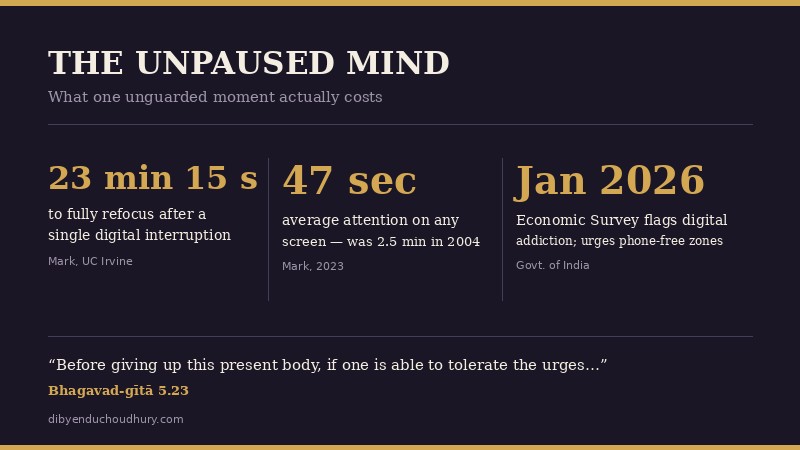
The Economic Survey 2026, tabled in the Rajya Sabha on 29 January 2026, devotes attention to digital addiction as a public-health and productivity concern. It recommends screen-time limits for children, simpler devices, school-based digital wellness education, phone-free zones, voluntary “digital diets”, awareness programmes in colleges and workplaces, and an expansion of Tele-MANAS, the national mental health helpline, to cover digital dependence specifically.
The most honest line in the whole treatment is the admission that India does not yet have reliable nationwide data on how excessive screen use is actually affecting people. Without it, the Survey notes, governments cannot design focused policy or budget for it sensibly. The second National Mental Health Survey is expected to close some of that gap.
Set against that policy vacuum, the research that does exist is sobering. Gloria Mark and her colleagues at the University of California, Irvine, following office workers through their actual days, found it takes an average of 23 minutes and 15 seconds to return fully to a complex task after a digital interruption — and that people typically do two other things before coming back to the original one. Her later work found the average attention span on any given screen had fallen to roughly 47 seconds, down from about two and a half minutes in 2004.
Here is what I think policy will struggle with. A phone-free zone is a wall around the stimulus. It is useful, and I support it. But it does not touch the gap. A person removed from their phone for two hours who spends those two hours in dhyayatah — dwelling, circling, rehearsing — has not paused. They have simply been interrupted by their own mind instead of by a device. The Gita’s intervention is upstream of the phone, which is why it survives the phone.
Five Pauses You Can Actually Install
Nothing in this tradition asks you to renounce your work, your family or your obligations. Krishna spends the whole of the Gita arguing the opposite — act, but act from a settled place. So the practices below are small on purpose. They are the ones I have found survive contact with an ordinary Indian working week.
- Name the surge before you obey it. When the pull arrives — to check, to reply, to argue — say the word vega to yourself once. Naming a thing puts a sliver of distance between you and it. That sliver is the gap, restored.
- Take one breath before the screen unlocks. Not a ritual, not ten minutes of anything. One deliberate inhale and exhale with your thumb hovering. You will find that a surprising fraction of unlocks simply do not happen once you insert this.
- Put a physical distance between you and the device at two fixed points a day. The Survey’s phone-free zone idea, scaled to one person. Morning tea and the last hour before sleep are the two that hold. Distance beats willpower, reliably.
- When anger arrives, delay the reply by one full night. This is the oldest advice in the world and it works because of 2.63 — anger is upstream of the memory failure, so anything you write while angry is written by someone who has temporarily forgotten what he actually wants.
- Keep a five-line evening reckoning. Where did I dwell today, what did that dwelling become, and where in the chain could I have intervened for almost nothing? Written, not thought — thinking about it is exactly the mode that has already failed you once today.
- Choose one thing each week you want and deliberately do not take. A small, harmless thing. The point is not the abstinence, it is the rehearsal — you are proving to yourself that wanting and doing can be separated at will.
Six weeks of the fourth one alone will change more about a professional life than most productivity systems manage in a year. I am fairly confident about that.
Reflect Is Not the Same as Ruminate
A caution, because this is where the instruction most often goes wrong in practice.
Pausing is not brooding. If you stop and immediately begin turning an old grievance over and over, you have not created a gap — you have gone straight to dhyayatah and started the chain from the top with better lighting. Rumination feels like reflection because both are quiet and internal. They are opposites. Reflection has a question and an end. Rumination has neither, and it leaves you more agitated than when you sat down.
The practical test is simple: after five minutes, are you clearer or merely more stirred up? If it is the second, the honest move is to stand up and do something with your hands. That is not failure. Krishna is emphatic in chapter three that inaction is not the goal and that the mind left idle will find its own trouble.
And if the stirring does not settle — if what surfaces in the quiet is heavier than a difficult week — that is worth taking seriously rather than meditating harder at. India now has Tele-MANAS precisely for this, and using it is a sign of judgement, not of weakness.
The title of this piece is a sequence, and the order matters. Pause first — make the gap. Reflect second — put one honest question into it. Live third, which is the part everyone forgets: the point of the gap is not to stay in it. It is to walk out of it having chosen, rather than having been carried.
Krishna calls the person who manages this sukhi nara — a happy human being. Not a liberated sage in a cave. A happy person, here, in this body, in this life, with the phone still on the desk.
Go deeper: The verses at the centre of this piece — the descent of 2.62–63 and the steadiness that answers it — are worked through line by line in The Steady Sage: Bhagavad-gita 2.47–72. For the same discipline applied to decision-making under pressure, see The Bhagavad Gita: Timeless Wisdom for Modern Leaders.